
With todays modern vehicle testing of Electric and Plug-in Hybrid Electric Vehicles there are new challenges. This is due to the increasing demands of the Electric Vehicle market, making the test cases and the testing procedures more complicated.
These high-tech vehicles, require high testing standards to meet the required level of precision.
Automotive companies need to balance testing coverage and risk with cost and time, without compromising on the quality and effectiveness of the vehicle functions.
Let’s identify the challenges and opportunities involved and the rapid advances in the Electric Vehicle market.
EV Market Growth
During COVID-19 pandemic, this didn’t stop manufacturers continuing to invest in Electric Vehicle research and development. Over the past 2 years, the EV’s have seen the strongest growth in the market.
There is such an increase in the demand for high-performance, cost-savings, fuel efficiency, and low-emissions of Electric Vehicles.
Due to the high demand for these vehicles, there is also an increase in demand for reliable, and comprehensive testing solutions for better performance, safety, and overall satisfaction.
Addressing the Challenges to Test EV’s
Unlike traditional vehicles, EVs are extremely different. These vehicles present a new set of challenges and risks at testing.
Powered by Lithium-ion batteries, or other evolving EV battery chemistries, EV powertrains consists of three main powertrain components:
- a battery pack with a battery management system
- traction inverters (1 or more)
- eMotors with gearboxes (1 or more). They are sometimes called an eAxle or eAxles.
Did you know that the DC battery power is converted by a high switching frequency traction inverter. Which is then inverted into a sinusoidal PWM waveform to power the high-speed AC eMotor. The onboard charger replenishes batteries from the power grid. Then a DC-to-DC converter steps down the power to lower voltage. Which is then used to control the heater, power windows, and other vehicle accessories components.
More top challenges in EV testing, are;
- lithium-ion battery testing
- battery simulation
- emulation for inverter
- eMotor testing
- increasing the energy levels of battery packs for long-range
- fast charging
- improving efficiency and reliability
- complying with the government regulations in terms of emission control and monitoring.
Addressing EV Charging Challenges
One of the major visual challenges, is the switch from having to fill up your vehicle with petrol/diesel, to having to charge up your vehicle like your mobile phone.
The charging systems are a challenging aspect of our growing vehicle infrastructure. This is due to the massive amounts of current, that needs to be transferred in the most expedient and efficient manner possible. Even though there are fixed charging stations, there are also onboard chargers that EV’s can serve themselves.
There are two major specifying groups with external charging systems, with three levels;
Level 1
This covers the power range from 1.44kW to 1.92kW, at 12A to 16A at 120VAC or 230VAC.
Level 2
Has ranges from 3.1kW to 19.2kW, at 15A to 80A in polyphase operation.
Level 3
This is from 120kW to 240kW, at up to 400A, at 300Vdc to 900Vdc.
Plug-in hybrid (PHEV) and battery electric (BEV) vehicles have battery voltage of around 450 V. However with the faster charging times and lighter cabling within the vehicle, there are higher voltages. For example; in a Porsche Taycan, it has a system voltage of 800V.
The International Electrotechnical Commission (IEC) has four power modes:
Mode 1
This is for slow-charging from a standard electrical socket, be it single- or three-phase.
Mode 2
The model 2 is for slow charging equipped with an vehicle-specific protection system.
Mode 3
Model 3 is for either slow or fast charging, using a multi-pin socket with control and protection functions (according to SAE J1772 and IEC 62196 standards).
Mode 4
This model is for fast charging, by using a special charger technology such as CHAdeMO or other systems that enable seamless communication between the vehicle and the charger.
The Combined Charging System (CCS) & On-board Charger
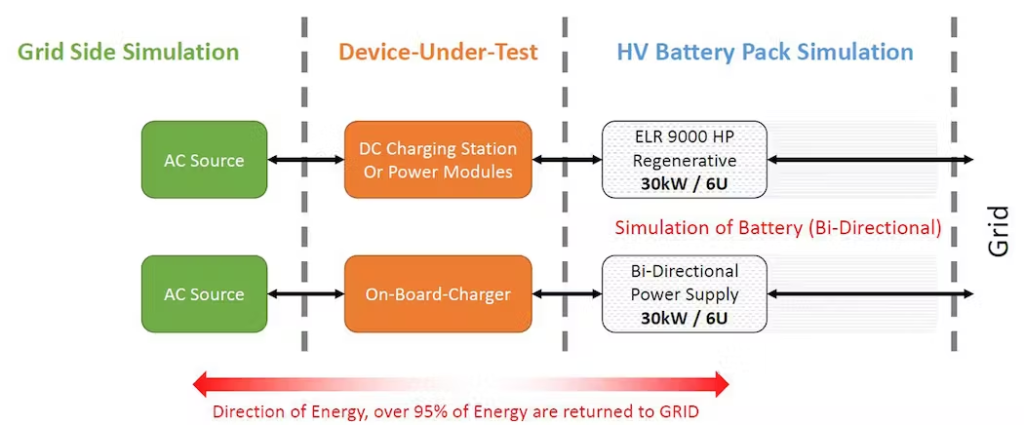
This combined charging system covers charging Electric Vehicles up to 350 kilowatts.
The on-board charger (OBC), which is inside the vehicle, is used to charge the traction battery.
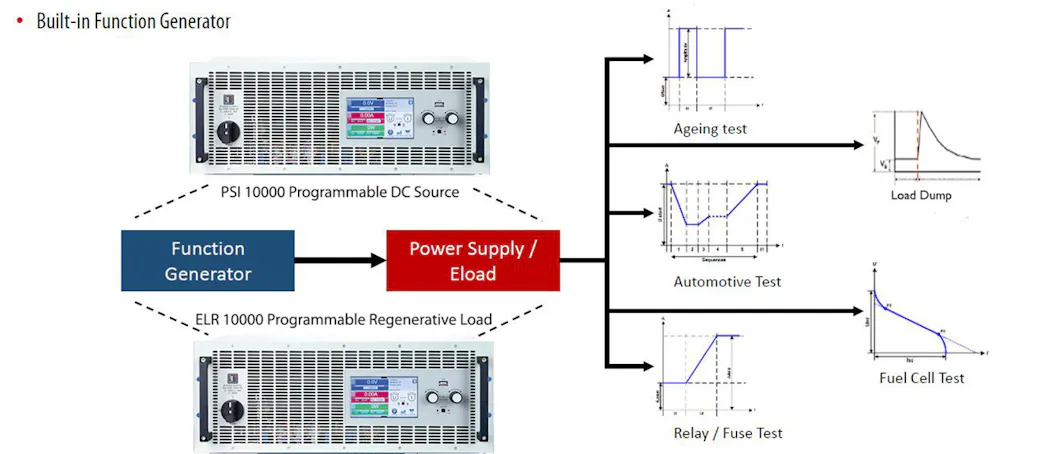
By using the latest generation of bidirectional, regenerative programmable power sources and loads, this provides a highly efficient means for conducting these tests.
The power-regulated DC-AC stage has various protection circuits, with an intuitive TFT touch panel with display for values, status, and notifications. The features include:
- remote sensing with automatic detection
- a galvanically isolated
- analog interface
- an integrated function generator
Electronic loads usually release the power transferred to them as heat. However, it can add up, especially in test applications where multiple systems are tested in parallel. Due to the need to remove the heat from the electronic loads, they are often large, with significant forced-air or water circulation to cool them down.
This usually causes an increase in the:
- test system cost
- size
- HVAC requirements – to control and remove the heat from the facility
The integrated regenerative source, can coherently move from the sourcing current sinking current without external circuits, or synchronized programming of a separate power supply and electronic load. This type of integration, enables a testing regimen that is not only accurate and effective, but also energy-efficient and cost-effective.
Testing Standards
There are standards, regulations, and guidelines on any testing in every field in engineering. To which the government oversees.
With energy efficiency at a premium for those who need to perform high-power tests, using bidirectional power testing solutions enables a significant reduction in the cost of operation and ownership. As well as increasing reliability and performance.
The built-in regenerative electronic load, is of great value in meeting the newest automotive electronics testing requirements.
Tests can be repeatedly performed by using bidirectional power supplies. There is no need for worry about overcharging, over-discharging, or deterioration of the rechargeable battery that is undergoing the test.
Conclusion
Nowadays it is no longer possible to carry out testing in only real-world conditions.
Importantly, it must be supplemented by other activities that can cope with the staggering volume of tests involved. Another important factor is to adhere to both challenging time and budgetary constraints.
In conclusion, testing of these high voltage vehicles is essential and must be tested in the correct manner. This is to adhere to the health and safety regulations and laws. Also taking into account that the testing on these vehicles can be time consuming and costly, so when testing these types of vehicles this needs to be taken into consideration.
Furthermore, the correct training is fundamental when testing these high voltage vehicles. Here at MTC we offer many Training Courses for Hybrid/EV and MOT training.
For More Information on Hybrid/EV Training
We offer a variety of courses, that can give you the knowledge and information you need about EV’s and Hybrid’s.
Hybrid Training Course, Level 1 – Raise Awareness
Hybrid/ EV Training Course, Level 2 – Light Vehicles
Buses – Hybrid Training Course, Level 2
Level 2 Hybrid Training Course – HGV’s
Hybrid Training Course Level 3 – Cars
The Level 1 Hybrid and Electric Training Course, is to raise awareness of Hybrid and Electric Vehicles.
This course is aimed at anyone that may come into contact with Hybrid and Electric Vehicles.
Level 2 Hybrid and Electric Light Vehicle Training Course, Level 2 HGV Training Course and Level 2 Buses Training Course. The Level 2 course is aimed at mechanics and car valeters.
The Level 3 Hybrid and Electric Training Course, is aimed at technicians and mechanics.
For more articles similar to this: Maintaining an EV & Hybrid


