

The most important part of MOT Testing is ensuring that the tools and MOT equipment are in good working order and meet the standard legal requirements.
MOT (Ministry of Transport) tests are a legal requirement for all vehicles aged three years or older. It is the MOT tester, or garage owners responsibility to ensure that all vehicles that are tested meet the minimum safety and environmental standards set by the government.
For an MOT test to take place, it is essential that the MOT testers at the garages have the necessary MOT training and equipment to carry out these tests accurately and efficiently.
In this blog, it will briefly cover both the MOT Equipment and MOT Tools that are necessary to perform an MOT test.
MOT Testing Bay

The first and most essential piece of equipment that is required at any MOT testing garage, is a designated MOT testing bay.
The MOT testing bay must be equipped with a roller brake tester, a headlamp tester and an emissions analyser, among other things.
Moreover, the MOT equipment layout of the test bays and pits, must meet minimum requirements.
Testing Bays
Did you know that the garages must have the test bay to have a vehicle entrance and exit, of at least 3.2m high by 3.0m wide. (If part of the brake test standing area, then the door must be at least 3.5m wide)
They also need to have a width of at least 4.2m and headroom of at least 3.2m (except over a lift). A headroom over a lift must have at least 4.8m measured from the platform surfaces when fully lowered. The headroom must extend 500mm further than the outer edges of the lift platform. As well as, extending 500mm to the front of the non drive on the end of the lift platforms and 1m to the rear of the drive on end of the lift platforms.
Double decker bays
The test bay entrances and exits for double decker vehicles must be at least, 4.6m high and 4.2m wide and have headroom of at least 5.0m. A headroom over a lift of at least 6.3m for double decker vehicles.
Single decker bays
A test Bay entrance and exit for single decker vehicles must be at least 3.7m high and 4.2m wide and have headroom of at least 4.0m. (except over a lift). Along with the headroom over a lift must have at least 5.3m for single decker vehicles.
Roller Brake Tester / Decelerometers
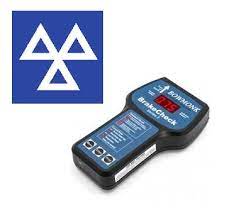
A roller brake tester, checks a vehicle’s braking performance. The roller brake tester, measures the force applied by the brakes on each wheel and can detect any discrepancies between them. This critical tool ensures that a vehicle is safe to be on the road.
However, there is an alternative tool which is a Decelerometer. This tool is where an RBT can’t be used. These handheld electronic devices can be taken in a vehicle during a test drive and brake test. This device tests the braking efficiency by calculating the rate of deceleration.
Headlamp Beam Tester
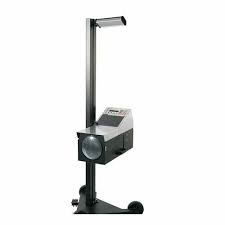
The headlight beam testers, are used to check the alignment and brightness of a vehicle’s headlights. This test is fundamental, to ensure that a driver has good visibility on the road and doesn’t blind the other drivers. A headlamp tester is an a very important and to ensure that vehicles meet the minimum safety standards required for the MOT test.
Emissions Analyser / Gas or Smoke Meters

In an MOT test, an emissions analyser is used to test a vehicle’s exhaust emissions. This impressive tool measures the number of harmful pollutants released by the vehicle, like: carbon monoxide and hydrocarbons. The emissions analyser tool is also important. This is to ensure that the vehicles meet the minimum environmental standards required for the MOT test.
MOT Lift / Ramp
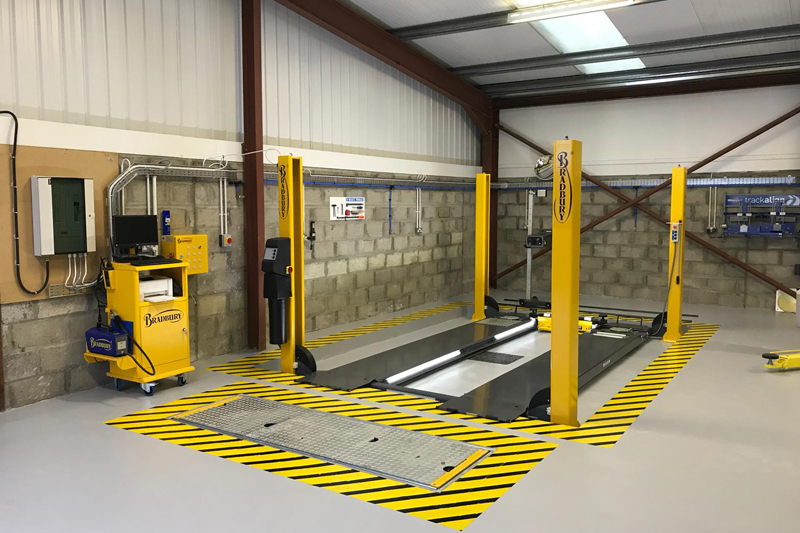
For the MOT tester to check underneath the vehicle, they use lifts and ramps. This is so that they can check a vehicle’s suspension, steering, and brakes, as well as its chassis and bodywork.
The most important part is that the vehicle lift is used for the correct class of vehicle they are testing.
A lift will be considered suitable if you meet the below requirements:
- A wheel supporting platform lift with platforms without upstands or guard rails are to be at least 4.8m long
- Rolled edges or vertical rails for jacking equipment must not be more than 25mm higher than the platform
- The platform length does not include access ramps
- MOT testing equipment should have a minimum clearance 0.5 metres around all parts of the MOT lift
- If a scissor lift is used, the scissors must be located underneath the platforms, allowing unobstructed access between them
- Platform surfaces are to be capable of being raised at least 1.4m from the floor (measured from the floor on which the tester stands)
- Adjustable platforms which allow the class of vehicle to be tested. A minimum of at least 760mm between the inner edges of the platforms and at least 2.1m between the outer edges
- A safe working load (SWL) of at least 3.5 tonnes clearly marked on the lift
- Jacking equipment clearly marked with a minimum SWL of 2.6 tonnes, capable of simultaneously raising both front or both rear wheels, (duplicated jacking equipment is acceptable)
- Heavy duty captive bearing based turning plates, positively secured to the platforms, which allows the wheels to be turned freely from lock to lock
- The turning plates must move laterally across the full platform width (when installed there must be a minimum distance of 4.2m from the centre of the turning plates to the drive on end of lift platforms)
- Chocks that operate automatically when the lift is raised, the 4.2m dimension for turning plates must not interfere with operation of the chocks
If a vehicle lift or ramp is not available, then an inspection pit can be used as an alternative.
Inspection Pit

An Inspection pit will only be considered suitable, if you meet the following requirements:
- A pit with an uninterrupted working length of at least 6.0m
- Has a minimum width of 760mm and not more than 1.3m over the working length measured across both pit walls
- A depth of at least 1.4m and not more than 1.8m over the working length (Staging may be used to meet this requirement)
- Adequate access for personnel which does not intrude on the working dimensions. Access steps may encroach on the required dimensions to an entrance/exit door or wall provided there is a minimum clearance width of no less than 600mm
- Sealed to prevent the ingress of water
- Jacking equipment as required for a lift. Rolled edges and vertical rails for jacking equipment must not exceed 25mm height
- Suitable captive bearing based turning plates, positively secured to the floor which permit the steered wheels to be turned freely from lock to lock
Diagnostic Equipment
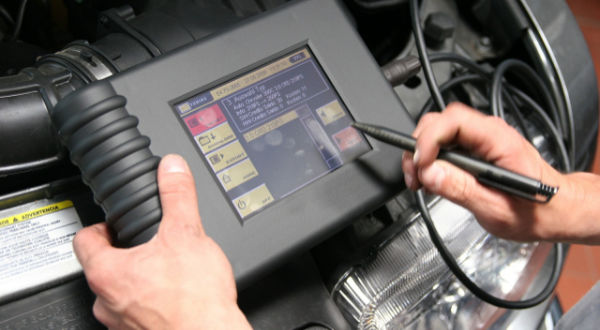
To identify any faults or issues with a vehicle’s electronic systems, a Diagnostic machines is used. This covers the engine management system, ABS system, airbag system and much more. Although, the diagnostic equipment isn’t essential for an MOT test, but it can be extremely helpful in finding out issues. These may include emissions issues caused by engine management faults, which could cause an MOT failure.
MOT Tools
The MOT Bay consists of a number of essential MOT Equipment.
However, there are also a number of ancillary tools that are used by MOT garages to ensure that the MOT test is fast and efficient.
Here is a list of some of the tools:
- MOT tool board (tool storage shadow panel boards)
- Tyre Depth Gauge
- Corrosion Assessment Tool (CAT), also known as the MOT hammer
- Lever and Pry bars
- Hand Lamps
- Brake Pipe Corrosion Tool
- Wire Brushes
- Turning radius plates
- Tapley or Bowmonk electronic brake efficiency test meters
- 13-pin Trailer Towing Socket tester
- MOT Notice Boards,
- Windscreen Damage Template
- Tyre Tread Width Gauge
- Brake Pedal Depressor
- MOT information posters
- MOT signs
Connecting Equipment to the MOT System
There are some types of equipment that can directly connect to the service you use to record MOT test results. Meaning that the test results can be automatically transferred to the service, without the need for manual data entry. Which better and cuts down the admin side.
Equipment that can’t connect
There are some types of equipment that at the moment aren’t able to connect to the service.
These are:
- pedal application devices
- plate brake testers
- tyre tread depth gauges
- wheel play detectors
- 13-pin Euro trailer socket wiring testers
Connecting the Equipment
To connect the equipment, you need a software code, called a ‘key’. This key will allow you to connect the equipment to the MOT testing service.
Your have to request for a key from the DVSA and this needs to be connected to the equipment in your test centre.
All keys have a unique code, so they will not work at another testing station and only works on one piece of equipment.
For similar articles like to this one: Renting MOT Equipment


